
15th Venice Architecture Biennale
The Chairs in Love
During the 15th Venice Architecture Biennale (exhibition Time Space Existence), Beatriz Gerenstein presented The Chairs in Love, a site-specific sculptural installation that merges contemporary sculpture with functional design.
Handcrafted in Italy from a rich composition of exotic woods, the two anthropomorphic chairs embody feminine and masculine energies, inviting reflection on love, companionship, and the timeless human need for connection.
The Chairs in Love, Wood. 2016. 40 x 60 x 29 inches (100 x 50 x 72.5 cm).
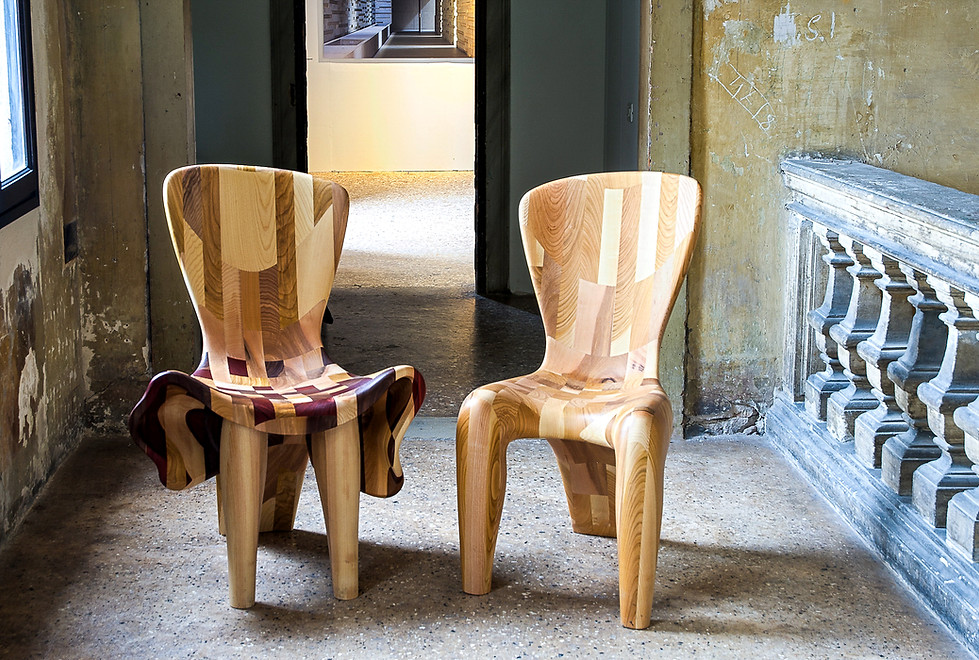


The Chairs in Love explores one of the most enduring themes in Beatriz Gerenstein's artistic practice: the human desire to find connection through another person. Conceived as both sculpture and functional furniture, the installation transforms two everyday objects into expressive human presences that quietly communicate without words.
Rather than representing two identical individuals, the chairs celebrate difference as the foundation of harmony. One chair suggests a feminine presence through its elegant curves and flowing silhouette, reminiscent of a graceful dress that extends beyond the seat. The other expresses a masculine character through stronger lines, greater visual weight, and a more grounded architectural form. Together they become a portrait of complementarity, where each identity remains distinct while finding meaning through the existence of the other.
The work draws inspiration from the universal human search for companionship and emotional intimacy. Throughout history and across cultures, love has often been understood as the meeting of two complementary beings whose differences create balance rather than opposition. Gerenstein translates this idea into sculptural form through subtle gestures: the chairs gently incline toward one another, their flowing contours suggesting proximity, dialogue, affection, and mutual respect.
Every chair was entirely designed and handcrafted in Italy by the artist using an intricate composition of carefully selected exotic woods. The natural variations in color, grain, and texture create a visual tapestry that symbolizes the richness of human individuality. Just as no two pieces of wood are identical, every relationship is built from unique experiences, personalities, and histories that together form a harmonious whole.
Installed within the historic rooms of Palazzo Mora during the exhibition Time Space Existence, The Chairs in Love established a compelling dialogue between Renaissance architecture and contemporary sculpture. Visitors were invited not only to contemplate the installation as an artwork but also to recognize its functional nature, blurring the traditional boundaries between sculpture, architecture, furniture, and design.
Ultimately, The Chairs in Love reminds us that even ordinary objects can become profound metaphors. More than chairs, they become silent companions—symbols of dialogue, intimacy, coexistence, and the enduring human hope of finding someone with whom to share life's journey.